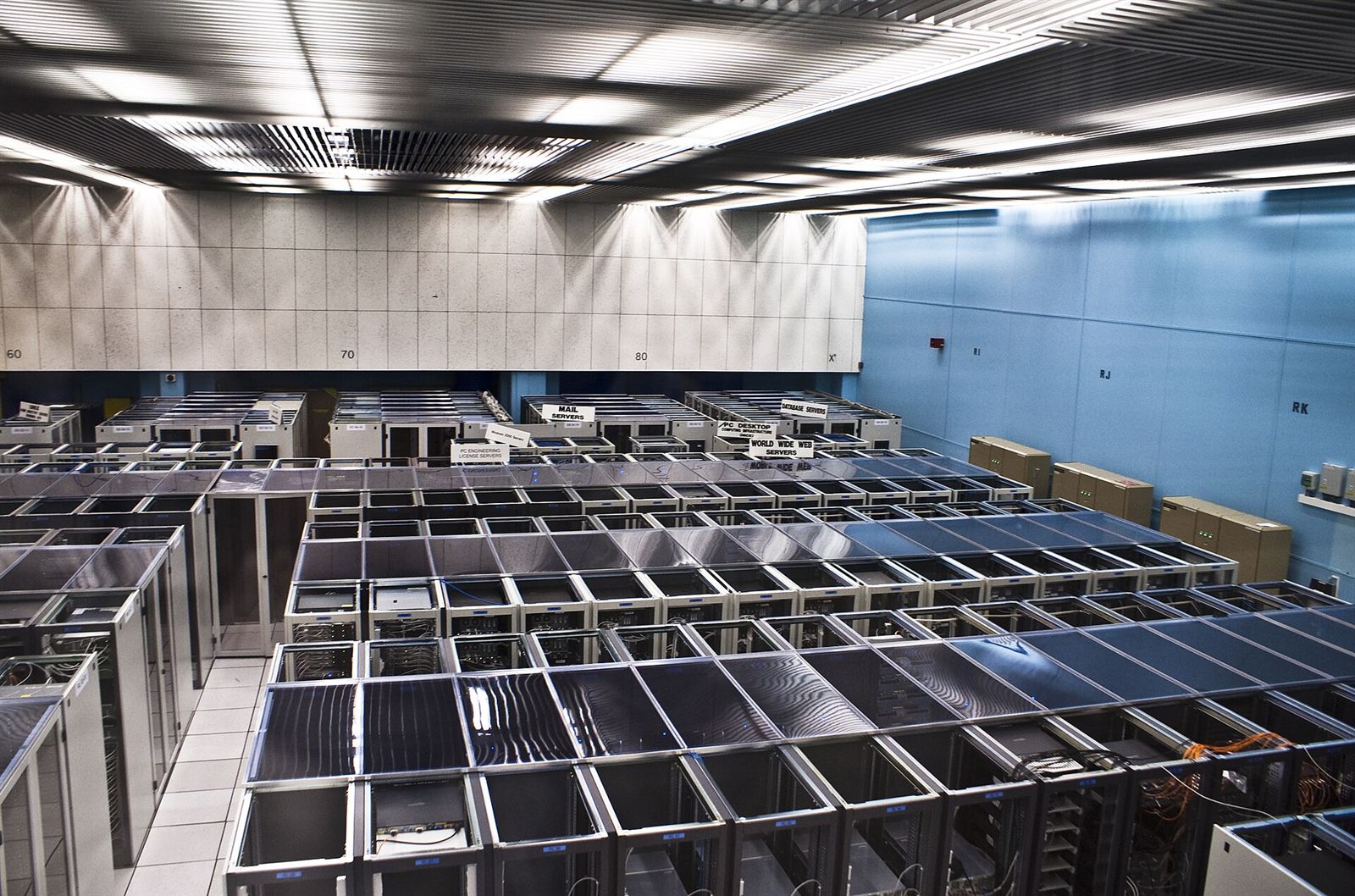

The Canadian ATLAS Tier-1 Data Centre
The Tier-1 Centre at SFU processes data recorded by the ATLAS experiment, so researchers can study particles like the Higgs boson.
It is one of ten ATLAS Tier-1 centres in the world, and is run by a consortium of ten Canadian institutions led by SFU and TRIUMF: the ATLAS-Canada collaboration, more than 150 researchers working on every part of the experiment.
What the Tier-1 Centre does
- Processing. Computing capacity to process LHC collisions recorded by ATLAS.
- Storage. Keeps raw and derived datasets from the experiment.
- Simulation and analysis. Runs simulations and physics analysis for researchers.
History
- 2007–2018The Tier-1 Centre is based at TRIUMF in Vancouver, created with support from the Canada Foundation for Innovation (CFI) and the B.C. Knowledge Development Fund.
- 2018As Canada consolidates research computing into a few national centres, the Tier-1 moves to the SFU data centre that also hosts the national supercomputer.
- 2026A new $5.3 million CFI award expands the centre for the High-Luminosity LHC, when ATLAS will record far more data.
Partner institutions
ATLAS-Canada brings together SFU and TRIUMF with:
- Carleton University
- McGill University
- Université de Montréal
- University of Alberta
- University of British Columbia
- University of Toronto
- University of Victoria
- York University
Who runs it
- Bernd Stelzer, SFU Professor of Physics. Scientific Director.
- Reda Tafirout, TRIUMF Research Scientist and Head of Scientific Computing. Director of Operations.
The Worldwide LHC Computing Grid
No single computer centre could handle all the LHC's data. CERN coordinates a worldwide network of computing centres, linked by grid software so that they act as one large system.
-
Tier-0
CERN
ATLAS records the collisions, and the data are sent out across the grid.
-
Tier-1
SFU, Burnaby
One of ten ATLAS Tier-1 centres. Stores and processes ATLAS data for Canada and the world.
-
Researchers
Physicists worldwide
Run simulations and analyses on the grid, including the SFU group's Higgs and new-physics searches.
Fir: Canada's fastest academic supercomputer
Fir became fully operational at SFU in September 2025, replacing the Cedar supercomputer.
It is the largest general-purpose research supercomputer in Canada and part of the national platform run with the Digital Research Alliance of Canada. When it launched it ranked 78th on the TOP500 list of the world's supercomputers, the only Canadian system in the top 100.
The Cedar Supercomputing Centre serves more than 17,000 researchers, about 70% of them outside B.C., in fields from particle physics to genomics and artificial intelligence. It runs on B.C.'s clean energy.
- CPU cores
- 165,888
- GPUs
- 640 × NVIDIA H100 (80 GB)
- Storage
- 50 PB high-performance
- TOP500 rank at launch
- 78th
- Investment
- Over $80 million
- Location
- SFU Burnaby campus
Learning to compute at scale
Students in the group learn to work with data at this scale, which prepares them for careers both in physics and in big-data computing.
Huge datasets
Analyze ATLAS collision data on the grid, alongside thousands of physicists worldwide.
Supercomputers
Run simulations and analysis on national research computing, right here on campus.
Skills that transfer
Programming, statistics and distributed computing that are valued well beyond physics.
Interested in physics and big data?
Students who want to do research using the Tier-1 Centre are welcome to get in touch.